LEISURE WITHOUT LITERATURE IS DEATH AND BURIAL ALIVE.

December 2007


Critics and poets, in all ages and countries tried to explain their own theory and practice of poetry. Wordsworth, too, expounded his views on poetry, its nature and functions, and the qualifications of a true poet in his Preface to the Lyrical Ballads.

On the nature of poetry, Wordsworth states that:
Poetry is the spontaneous overflow of powerful passion.
Internal feelings of the poet proceeds poetry. It is a matter of feeling and temperament. True poetry cannot be written without proper mood and temperament. It cannot be produced to order. It must flow out freely and willingly from the soul as it cannot be made to flow through artificially laid pipes. Secondly, poetry is a matter of powerful feelings. It is never an intellectual process.
Poetry is born not in the mind but in the heart overflowing with feelings.
Poets are gifted with greater organic sensibility. They have greater ability to receive sense impressions. Beauties of nature, which may leave ordinary mortals untouched, excite poet’s powerful emotions and he feels an urge to express them. Wordsworth’s heart leapt up with joy on beholding a rainbow or daffodils dancing in the breeze and he expressed his overflowing feelings spontaneously in his immortal poems.

According to Wordsworth, good poetry is never an instant expression of powerful emotions. A good poet must meditate and ponder over them long and deeply. Poetry has its origin in “emotions recollected in tranquility”. Experience has to pass at least four stages before successful composition becomes possible. Firstly, there is the observation or perception to some object, character or event which sets up powerful emotions in poet’s mind. Secondly, there is recollection and contemplation of that emotion in silence. In this stage, memory plays a very important part. An interval of time must elapse, in which the first experience sinks deep into the poet’s insight and becomes his part and parcel. During the interval, the mind ponders and the impression received is purged of the unneeded elements or superfluities and is “qualified by various pleasures”. This filtering process is very slow; time and solitude are vital. Thus, the poet’s emotion is universalized. Thirdly, the interrogation of memory by the poet sets up, or revives, the emotion in “the mind itself”. It is very much like the first emotion, but is purged of all superfluities and constitutes a “state of enjoyment”.

This does not mean that the creative process is a tranquil one. The poet points out that in the process of contemplation, “tranquility disappears”. The poet has to “passion anew” while creating and is terribly exhausted as a result. But creation, if it be healthy, carries with it joy or “an over-balance of pleasure”. On the whole, “the mood of imaginative creation is enjoyment”. The ability to create comes from nature and not from premeditated art.

The fourth and last stage is of composition. The poet must convey that “overbalance of pleasure” and his own “state of enjoyment” to others. He differs from ordinary individuals in communicating his experience to others in such a way as to give pleasure. Metre is justified for it is pleasure super-added:
Verse will be read a hundred times where Prose is read only once.
Wordsworth himself closely followed his theory. He rarely made, “a present joy the matter of a song”. He did not poetize an experience immediately; his hardly ten poems are described unplanned. His composition had a wide interval between an experience and its poetic delineation. He had a powerful memory and at times he would fetch out an impression, “from hiding places ten years deep”. All his best poems resulted from emotions recollected in tranquility.

Recalling in silence enables the poet to see into the things deeply and converse the very soul of an experience to his readers. Through such contemplation the poet is able to impart to everyday object a ‘visionary gleam’, a ‘glory’, a ‘light that never was on land and sea’. As such recollection is best done in solitude, the poet loved lonely places, liked to wander all alone, lost in reverie, and was known by the rustics of Cumberland as the Solitary.

Wordsworth asserts that the function of poetry is to give pleasure. Even the painful subject should give pleasure. The poet in a “state of enjoyment” must commune this enjoyment to his readers. But pleasure is not the only and the chief aim of poetry. It is not an entertainment or a pastime. He tells:
It is the breath and finer spirit of all knowledge, the impassioned expression that is in the countenance of all science.
To be incapable of poetic feeling is to be without love of human nature and reverence of God. Its mission is to:
Arouse the sensual from their sleep of Death. And win the vacant and the vain to noble Rapture.
Poetry must serve the purposes of life and morality.
Poetry divorced from morality is valueless.
He hoped to console through his own poetry, the afflicted, to add sunshine to daylight, to lead the people to see, to think and to feel and become more virtuous.

Any subject can be poetically treated but Wordsworth favored incidents and characters from low and rustic life. He made the folks of Cumberland, their lives and objects of nature, the subjects of his poetry, for in rustic life the basic passions and emotions can be observed more clearly and expressed more perfectly. Such elementary passions in rural settings are linked with, “the beautiful and permanent forms of nature”. For Wordsworth it is the feeling and emotion that is important and not action and situation.
Feeling developed in a poem gives importance to the action and situation and not the diction and situation to the feeling.
Wordsworth's theory of poetic diction was a direct outcome of his democratic preference for simple rustic life and characters. When the theme was simple, the language must be simple too. It must be a selection of the language really spoken by such men otherwise it would not be in character. He is, therefore, critical of the artificial poetic diction of 18th century poetry.

tess fate and chanceChance and coincidence play a vital role in all the novels of Hardy. While character is certainly responsible to a large extent for the undoing of human lives in Hardy’s fiction, chance and coincidence often operate as the deciding factors. Hardy felt that an evil power ruled the universe, defeating every endeavour of man to better his fortune or to find happiness. He could not believe in a benevolent Providence; events were too plainly ironical, so they must have been contrived by a supernatural power. He believed that fate or destiny was sometimes indifferent, but most often hostile, to human happiness. One manifestation of the hostility of fate is to be found in the irony of circumstances that we meet with in Hardy’s novels. In other words, when human beings are not themselves responsible for the frustration of their hopes, or when their own temperaments and mutual conflict do not wreck their happiness, fate intervenes in the shape of chance or accident or coincidence to contribute to, or to complete, their ruin.

Early in the story, Prince, the horse of the Durbeyfield Family is killed in an accident. Tess’ father being in no condition to undertake an important journey, Tess offers to take his place. As she is driving the wagon carrying a load of beehives to be delivered in a distant market, the mail van coming from the opposite side collides against Tess’ wagon and Prince is fatally wounded. This accident has a profound influence on the life of Tess. The family business having become suddenly disorganized by the death of the horse, it becomes necessary for Tess to contract the D’Urbervilles living at “The Slopes” for help, and the meeting between her and Alec which follows leads to consequences which are disastrous. Alec’s seduction of Tess is a direct, though not immediate, result of the death of Prince. A sheer accident is responsible for this seduction which eventually proves the undoing of her marriage with Angel Clare.

Another notable mischance that deeply affects Tess’ life is her written confession, pushed by her under Angel’s door, going under the carpet and not reaching Angle at all. Being an honest and conscientious girl, Tess tries her utmost to acquaint Angel with her past history, but all her efforts prove futile for one reason or another. Finally, when a chance meeting with a Trantridge man at a town inn leads to an unpleasant situation, Tess decides to take no risk and writes down an account of her experience with Alec in order to tell Angel of the secret of her life. If Angel had received this statement of the facts in time, he would have either forgiven her or would have been averted. Since he learns the secret after the marriage, Angel adopts a stiffer and more rigid attitude that he might have done if he had learnt it before the marriage. After separating from Tess, Angle goes to Wellbridge to wind up certain affairs, he kneels by the bedside and says:
Oh, Tess! If you had only told me sooner, I would have forgiven you.
A minor mischance thus has grave consequences.

Chance and coincidence play yet another impish trick in the novel. Tess, in her misery, decides to visit Angle’s parents at Emminster. After walking a distance of fifteen miles when she arrives at the Vicarage, it so happens that Mr. and Mrs. Clare are not at home. She turns away, deciding to come back after a while, but it so happens that she overhears the tow brothers of Angel talking about Angle’s wife in a most disparaging manner. She feels much hurt by this conversation, but another chance now occurs. The tow brothers meet Miss Mercy Chant and all three of them comment adversely on a pair of boots which they discover behind a bush. The boots belong to Tess, and the comment hurts her still more. Tess had hidden her thick hoots behind the bush and put on thin ones of patent leather in order to look pretty to her parents-in-law. But Angel’s brothers and Mercy Chant take these boots to be a beggar’s. Tess’ feelings are now so wounded that she changes her mind and decides to return to Flintcomb Ash without meeting Angel’s parents. If she had been able to meet Angel’s parents, he subsequent life would have changed of the better because, as Hardy tells us:
Her present condition was precisely one which would have enlisted the sympathies of old Mr. and Mrs. Clare.
Another mischance that brings disaster into Tess’ life is her unexpected meeting with Alec. For three or four years the two have never happened to meet on any occasion, and now, when Tess’ salvation lay only in continuing to keep out of his way, she runs into him. The meeting awakens Alec’s dormant lust once again; he renounces his missionary’s role and pursues Tess with a doggedness that surprises her. If this chance meeting had not occurred all would yet have been well with Tess. Clare was coming to claim her and she would at least have been re-united with him to spend the rest of her life blissfully in his arms. But a chance meeting with Alec becomes fate’s device for wrecking her chances of happiness.

Another circumstance now occurs to aggravate the. Tess’ mother falls seriously ill and her father becomes unwell too. Tess gives up her job and rushes home. As chance would have it, her father dies while her mother recovers – contrary to expectations. The death of her father means the eviction of the family from their cottage of Marlott and their becoming homeless. The house-owner at Kingsbere, by another mischance, hands over the possession of his house to another tenant, after having promised it to Tess’ mother. This misfortune is an ideal opportunity for Alec to put further pressure upon Tess who sees no way out of the predicament but to yield. Thus a number of chance happenings seem to conspire against any possibility of Tess’ achieving happiness in life. Her surrender to Alec, which completes her ruin, thus comes about as a result of coincidences.

The excessive use of chance and coincidence by Hardy makes his stories somewhat implausible. It is true that chance and coincidence do play a certain role in every man’s life, but this role is a limited one. There are in real life happy accidents as well as sad ones. What exposes Hardy’s stories to adverse criticism is firstly that chance plays too frequent a part in human life and secondly that this part is always hostile to the characters.

In short, Hardy spoils his case by overstatement and exaggeration. He seems to manipulate fate against his characters by showing chance and coincidence at work again and again. However, in “Tess of the D’Urbervilles”, the logic of cause and effect plays a greater role in the tragedy than chance and coincidence. The realism of this story is therefore not weakened by the use of this device to a large extent.

Peasant World


It cannot be denied that “Tess of the D’Urbervilles” is a social document showing the final tragic stage of the disintegration of the English peasantry but to over-emphasize this aspect and to reduce the importance of the novel as a personal tragedy does not seem to be the correct approach.

It is true that Tess is a peasant girl and that her struggles and misfortunes, to some extent, do represent the sufferings of the peasantry. The accident in which the family horse is killed symbolizes the struggles of the peasantry. Tess’ sense of guilt over this accident forces her to seek the help of the prosperous D'Urbervilles of Trantridge. Her sacrifice to Alec D’Urberville is symbolic of the historical process at work. Tess, as a worker, is handed over by her mother under economic stresses, to the life and the mercies of the ruling class.

Tess’ seduction by Alec, makes her story a hopeless struggle, against strong odds, to maintain her self-respect. After the death of her child she becomes a milk-maid at Talbothays. Here she falls in love with Angel, marries him, and is soon discarded by him. Angel personifies social convention even though he pretends not to believe in it. At the time of his desertion of Tess, Angel symbolizes the rigid, orthodox code of morality with a double standard – one for men and another for women.

Hardy was intensely aware of the changes in the countryside and the effects of economic change on society. Tess is an example of the social mobility of industrialism. But social mobility went two ways. Because of enclosures and industrialism, the traditional shape of the English farm village was changing. Workers were forced off their land and turned into proletarians, either industrial or agricultural.

One of the memorable scenes in the novel is the threshing at Flintcomb-Ash farm, where Tess with other women serves that “red tyrant”. The machine is importunate, inhuman, insatiable. The old workmen sadly recall the threshing work they used to do with their hands. The engineer operating the machine is described as being “in the agricultural world, not of it”. He and his machine are like Alec who is equally importunate, inhuman, and insatiable. The machine is as repetitious and as powerful as Alec.

The threshing scene symbolizes the dehumanized relationships of the new capitalist farms.

The final blow to Tess’ self-respect comes with the death of her father and the consequent expulsion of the family from their cottage. Cottagers who were not directly employed on the land were looked upon with disfavour. It is the need to support her family that finally forces Tess back to Alec.

Certainly Tess of the D’Urbervilles depicts the disintegration of the English peasantry and is certainly a social and industrial tragedy. However, a balance should be maintained between this approach to the novel and the personal tragedy. Hardy’s main emphasis is on Tess, not as a typical peasant girl but as an individual. Hardy deals with the theme of the decline and destruction of the English peasantry by Tess; but it is not the dominant theme. The English peasantry does arouse our sympathy but we think of Tess not as an agent of the peasantry but as an individual girl, for if Tess is typical, she is also unique.

In several ways Tess stands above her peasantry class. In the first place, she has a delicate conscience which disturbs her peace of mind after her seduction. She suffers from a constant sense of guilt because of her past when she has fallen in love with Angel. Secondly, she is a hypersensitive girl. Not every peasant girl thinks that mankind lives on a “blighted” planet and suffers from the “ache of modernism”. This sensitivity makes her, after Angel’s desertion, suffer a mental torture. The difference between Tess as an individual and as a peasant becomes clear when she thinks of her mother’s reactions towards her. Her mother accepts the seduction stoically and urges her not to reveal her past to her husband. The mother is quite thick-skinned.

The true representative of the peasantry is the mother, not Tess. Tess has surely sprung from the peasantry but her thoughts and her feelings lift her far above the peasantry. We think of Tess betrayed by her seducer, betrayed by her husband, betrayed by circumstances; we think of an innocent victim of the dishonesty and traditionalism respectively of two men, and an innocent victim of the hostility of fate. The theme of the disintegration of the peasantry is secondary to the tragedy of an individual woman.


john donne loveDonne was the first English poet to challenge and break the supremacy of Petrarchan tradition. Though at times he adopts the Petrarchan devices, yet his imagery and rhythm, texture and colour of his love poetry is different. There are three distinct strains of his love poetry – Cynical, Platonic and Conjugal love.

Giving an allusion to Donne’s originality as the poet of love, Grierson makes the following observation:
His genius temperament and learning gave a certain qualities to his love poems … which arrest our attention immediately. His love poems, for instance, do have a power which is at once realistic and distracting.
Donne’s greatness as a love-poet arises from the fact that this poetry covers a wider range of emotions than that of any previous poet. His poetry is not bookish but is rooted in his personal experiences. Is love experience were wide and varied and so is the emotional range of his love-poetry. He had love affairs with a number of women. Some of them were lasting and permanent, other were only of a short duration.

Donne is quite original in presenting the love situations and moods.

The “experience of love” must produce a “sense of connection” in both the lovers. This “sense of connection” must be based on equal urge and longing on both the sides.
The room of love” must be shared equally by the two partners.
Donne magnifies the ideal of “Sense of connection” into the physical fulfillment of love.
My face in thine eyes thine in mime appears
This aspect of love helps him in the virtual analysis of the experience of love. Donne was a shrewd observer who had first hand knowledge of “love and related affairs. That is why in almost all his poems, he has a deep insight.

His love as expressed in his poetry was based not on conventions but on his own experiences. He experienced all phase of love – platonic, sensuous, serene, cynical, conjugal, illicit, lusty, picturesque and sensual. He could also be grotesque blending thought with passion.

Another peculiar quality of Donne’s love lyrics is its “metaphysical strain”. His poems are sensuous and fantastic. Donne’s metaphysical strain made his reader confused his sincerity.

Donne’s genius temperament and learning gave to his love poems power and fascination. There is a depth and rang of feeling unknown to the majority of Elizabethan poets. Donne’s poetry is startlingly unconventional even when he dallies, half ironically, with the hyperboles of petrarch.

John Donne is realistic not an idealistic. He knows the weakness of Flesh, the pleasure of sex, the joy of secret meeting. However he tries to establish a relationship between the body and the soul. Donne is very realistic poet.

Grierson distinguished three distinct strains in it. First there is the cynical strain. Secondly, there is the strain f conjugal love to be noticed in poems like “valediction: forbidding mourning”. Thirdly, there is platonic strain. The platonic strain is to be found in poems like “Twicknam Garden”, “The Funeral”, “The Blossoms”, and “The Primroses”. These poems were probably addressed to the high-born lady friends. Towards them he adopts the helpless pose of flirtations and in high platonic vein boasts that:
Different of sex no more we know

Than our Guardian Angles doe
In between the cynical realistic strain and the highest spiritual strain, there are a number of poems which show an endless variety of mood and tone. Thus thee are poems in which the tone is harsh, others which are coarse and brutal, still other in which he holds out a making threat to his faithless mistress and still others in which he is in a reflective mood. More often that not, a number of strains and moods are mixed up in the same poem. This makes Donne as a love poet singularly, original, unconventional and realistic.

Whatever may be the tone or mood of a particular poem, it is always an expression of some personal experience and is, therefore, presented with remarkable force, sincerity and seriousness. Each poem deals with a love situation which is intellectually analyzed with the skill of an experienced lawyer.

Hence the difficult nature of his poetry and the charge of obscurity have been brought against him. The difficulty of the readers is further increased by the extreme condensation and destiny of Donne’s poetry.

The fantastic nature of the metaphysical conceits and poetry would become clear even we examine a few examples. In “Valediction: Forbidden Mourning” true lovers now parted are likened to the legs of a compass. The image is elaborated at length. The lovers are spiritually one, just as the head of the compass is one even when the legs are apart. One leg remains fixed and the other moves round it. The lover cannot forget the beloved even when separated from her. The two loves meet together in the end just as the two legs of the compass are together again, as soon as circle has been drawn.

At other times, he uses equally extravagated hyperboles. For example, he mistakes his beloved to an angel, for to imagine her less than an angle would be profanity.

In Donne’s poetry, there is always an “intellectual analysis” of emotion. Like a clever lawyer, Donne gives arguments after arguments in support of his points of view. Thus in “Valediction: Forbidden Mourning” he proves that true lovers need not mourn at the time of parting. In “Canonization” he establishes that lovers are saints of love and in “The Blossome” he argues against the petrarchan love tradition. In all this Donne is a realistic love poet.

Gulliver’s Travels” is a great work of social satire. Swift’s age was an age of smug complacency. Corruption was rampant and the people were still satisfied. Thus, Jonathan Swift tears the veil of smug complacency off which had blinded the people to realities. In “Gulliver’s Travels”, there is a satire on politics, human physiognomy, intellect, manners and morality.

gulliver's travel satire

In the first voyage to Lilliput, Swift satirizes on politics and political tactics practiced in England through Lilliputians, the dwarfs of six inches height. He satirizes the manner in which political offices were awarded by English King in his time. Flimnap, the Treasurer, represents Sir Robert Walpole who was the Prime Minister of England. Dancing on tight ropes symbolizes Walpole's skill in parliamentary tactics and political intrigues. The ancient temple, in which Gulliver is housed in Lilliput, refers to Westminster Hall in which Charles I was condemned to death. The three fine silk threads awarded as prizes to the winners refer to the various distinctions conferred by English King to his favourites. The Lilliputians were highly superstitious:
They bury their dead with their head directly downwards because they hold an opinion that after eleven thousand moons they are all to rise again.
Gulliver’s account of the annoyance of the Empress of Lilliput on extinguishing fire in her apartment is Swift’s satirical way of describing Queen Anne’s annoyance with him on writing “A Tale of a Tub”. Swift’s satire becomes amusing when Gulliver speaks of the conflict between the Big Endians and the Little Endians. In this account Swift is ridiculing the conflicts between the Roman Catholics and the Protestants. High Heel and Low Heel represent Whig and Tory – two political parties in England.

Gulliver travel satireIn the second voyage to Brobdingnag, there is a general satire on human body, human talents and human limitations. Gulliver gives us his reaction to the coarseness and ugliness of human body. When Gulliver gives an account, to the King of Brobdingnag, of the life in his own country, the trade, the wars, the conflicts in religion, the political parties, the king remarks that the history of Gulliver's country seems to be a series of conspiracies, rebellions, murders, revolutions and banishments etc. Kind condemns the fatal use of gunpowder and the books written on the act of governing. King mocks at the human race of which Gulliver is the agent.
The most pernicious race of little odious vermin that nature ever suffered to crawl upon the surface of the earth.
Swift here ridicules human pride and pretension. The sight is, indeed, horrible and disgusting. Among the beggars is a woman with a cancer in her breast.
It stood prominent six feet, and could not be less than sixteen in circumference … spots and pimples that nothing could appear more nauseous.
There is a man with a huge tumor in his neck; another beggar has wooden legs. But the most hateful sight is that of the lice crawling on their clothes. This description reinforces Swift views of the ugliness and foulness of the human body.

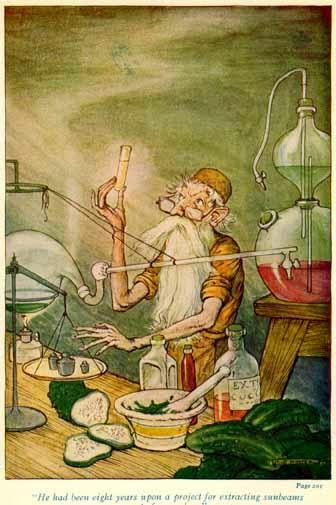
Gulliver's travel satireIn the third voyage to Laputa, there is a satire on human intellect, human mind and on science, philosophy and mathematics. However, his satire is not very bitter. We are greatly amused by the useless experiments and researches, which are going on at the academy of Projectors in Lagado. Here scientists wants to extract sunbeams out of cucumbers, to convert human excrement into its original food, to build house from the roof downward to the foundation, to obtain silk from cobwebs and to produce books on various subjects by the use of machine without having to exert one’s brain.
Their heads were inclined either to the right or to the left, one of their eyes turned inward, and the other directly up to Zenith.
Swift amuses us by making a fun of the people whose sole interests are music and geometry.
They made a lot of theories but practically nill.
Swift here ridicules scientists, academics, planers, intellectual, in fact, all people who proceed, only according to theory which are useless when they come to actual practice. He satirizes historian and literary critics though Gulliver’s interviews with the ghosts of famous dead. The point of satire is that historian often distorts facts and literary critics often misinterpret great authors like Homer and Aristotle.

In the fourth voyage to Houyhnhnms, there is a bitter poignant satire on human moral shortcomings. Voyage contains some of the most corrosive and offensive satire on mankind. The description of the Yahoos given to us by Gulliver is regrettable.
Yet I confess I never say any sensitive being so detestable on all accounts; and the more I came near them, the more hateful they grew.
Gulliver's travel satireBy contrast, the Houyhnhnms are noble and benevolent horses who are governed by reason and lead an ordered life. It is, indeed, a bitter criticism on the human race to be compared by the Houyhnhnms. The satire deepens when Gulliver gives an account, to the master Houyhnhnms, of the events in his country. He tells him that war in European countries was sometimes due to the ambition of kings and sometimes due to the corruption of the ministers. He speaks of the numerous deadly weapons, employed by European nations for destructive purposes. Many people in his country ruin themselves by drinking, gambling and debauchery and many are guilty of murders, theft, robbery, forgery and rape. The master speaks of the Yahoo’s love of shinning stones, their gluttony and their weakness for liquor. The master also speaks of the lascivious behaviour of the female Yahoos. By contrast, the Houyhnhnms are excellent beings.
Here was neither physician to destroy my body not lawyer to ruin my fortune; no informer to watch my words and actions … here were no … backbiters, pickpockets, highwaymen, house-breakers … politicians, wits … murderers, robbers … no cheating shop-keeper or mechanics, no pride, vanity or affectation.
They hold meetings at which the difficulties of their population are discussed and solved. They regulate their population and do not indulge in sexual intercourse merely for pleasure.
Everything is calculated as the Plato’s Utopian land ‘The Republican’.
Swift’s purpose here is to attribute to horses certain qualities which would normally be expected in human beings but which are actually lacking in them. Gulliver’s reaction o Houyhnhnms fills him so much admiration for them and with so much hatred and disgust for human beings that he has no desire even to return to his family.

Thus we see that “Gulliver’s Travels” is a great piece of art containing social satire in it. Every satirist is at heart a reformist. Swift, also, wants to reform the society by pinpointing the vices and shortcoming in it. And he very successfully satirizes on political tactics, physical awkwardness, intellectual fallacies and moral shortcomings.

Oedipus Rex” is a tragedy of fate. The crucial events in the play have been pre-determined by fate or the gods. Man seems helpless facing the circumstances which mould his destiny. King Laius was told that his own son by Jocasta would kill him. Laius did everything possible to prevent such a disaster. Once Jocasta gave birth to a son, Laius had him chained and handed him over to a trustworthy servant with strict orders that the child be exposed on. Mt. Cithaeron and allowed to perish. But the servant, out of compassion, handed over the child to a Corinthian shepherd who passed him on to the Corinthian King. The child grew up as the son of the King and Queen of Corinth and later killed his true father, Laius, in complete ignorance. Apollo’s oracle was fulfilled even though Laius and Jocasta took the extreme step to escape the fate foretold by the oracle.

Oedipus had also to submit to the destiny which Apollo's oracle pronounced for him. He learnt from the oracle that he would kill his own father and marry his own mother. He, too, tried his utmost to avert a terrible fate and fled from Corinth. His wanderings took him to Thebes, where people were facing a great misfortune. King Laius had been killed and the city was in the grip of the Sphinx, who was causing a lot of destruction because nobody was able to solve her riddle. Oedipus solved the riddle and put an end to the monster. Oedipus was joyfully received by Theban people as their King and was given Laius’s widow as his wife. Thus, in complete ignorance of the identity of his parents, he killed his father and married his mother. He performed these disastrous acts not only unknowingly, but as a result of his efforts to escape the cruel fate which the oracle at had communicated to him.
unity of action

It is evident that the occurrences which bring about the tragedy in the life of Laius, Oedipus, and Jocasta are the work of that mysterious supernatural power called fate or destiny or be given the name of Apollo. This supernatural power had pre-determined certain tragic events and even informed the human beings in advance. These human beings take whatever measures, to avert those events; and yet things turn out exactly as they had been foretold by the oracles. Oedipus has done nothing at all to deserve the fate which overtakes him. Nor do Laius and Jocasta deserve the fate they meet.

According to Aristotle the tragic hero is a prosperous man who falls into misfortune due to some serious defect or hamartia. No doubt that Oedipus is an able ruler, a father of his people, a great administrator and an outstanding intellect. His chief care is not for himself but for the people of the State. The people look upon him as their savior and worshipped him. He is also a religious man in the orthodox sense. That such a man should meet the sad fate is unbearably painful to us.

Oedipus is not, however, a perfect man or a perfect King. He does suffer from a hamartia or a defect of character. He is hot-tempered, rash, hasty in judgments, easily provoked and somewhat arbitrary. Though in the beginning his attitude towards Teiresias is one of reverence, he quickly loses his temper and speaks to the prophet in an insulting manner accusing both him and Creon of treason and showing a blind suspicion towards friends. His position and authority seem to be leading him to become a tyrant. Creon has to remind him that the city does not belong to him alone. Even when blinded he draws the reproach:
Do not crave to be master in everything always.
All this shows that Oedipus is not a man of a flawless character, not completely free from faults, not an embodiment of all the virtues. His pride in his own wisdom is one of his glaring faults. His success in solving the riddle of the Sphinx further developed his inherent feeling of pride. There is in him a failure of piety even. Under the influence of Jocasta, he grows sceptical of the oracles. Thus there is in him a lack of true wisdom which took him on the verge of becoming an impious tyrant.

If Oedipus had not been hot-tempered, he might not have got entangled in a fight on the road and might have not been guilty of murdering his father. Similarly, if he had been a little more cautious, he might have hesitated to marry a woman old enough to be his mother. After all there was no compulsion either in the fight or in his marriage. Both his acts may thus be attributed to his own defects of character. All at once it has to be accepted that the decree of the oracles were inescapable. Even if Oedipus had taken the precautions, the prophecy was to be fulfilled. The oracle’s prediction was unconditional; it did not say that if Oedipus did such and such a thing he would kill his father and marry his mother. The oracle simply said that Oedipus would kill his father and marry his mother. What the oracle said, was bound to happen.

If Oedipus is the innocent victim of inescapable doom, he would be a mere puppet and the play becomes a tragedy of destiny which denies human freedom. Sophocles does not want to regard Oedipus as a puppet; there is reason to believe that Oedipus has been portrayed largely as a free agent. The attendant in the play insistently describes Oedipus’ self-blinding as voluntary and distinguishes it from his involuntary murder of his father and marriage with his mother. Oedipus’ actions were fate-bound, but everything that he does, he does as a free agent – his condemnation of Teiresias and Creon, his conversation with Jocasta to reveal the facts, his pursuing his investigation despite the efforts of Jocasta and the Theban shepherd to stop him, and so on. Oedipus, freely choosing a series of actions, led to his own ruin. Oedipus could have left the plague to take its course but his pity over the sufferings of his people forced him to consult the oracle. He could have left the murder of Laius uninvestigated, but his love of justice obliged him to inquire. He need not have forced the truth from the reluctant Theban shepherd but he could not rest content with a lie. Teiresias, Jocasta, the Theban shepherd each tried to stop Oedipus, but he was determined to solve the problem of his own parentage. The direct cause of his ruin is not fate; no oracle said that he must discover the truth. Still less does the cause of his ruin lie in his own weakness. His own strength and courage, his loyalty to Thebes and his love of truth causes his ruin. All this shows him a free agent.

In spite of the facts that Oedipus is a free agent in most of his actions, still the most tragic events of his life – his murder of his father and his marriage with his mother – had inevitably to happen. Here the responsibility of fate cannot be denied. The real tragedy lies in the discovery of truth, which is due to his own traits. If he had not discovered the truth, he would have continued to live in a state of blissful ignorance and there would have been no tragedy and no suffering. But the parricide and the incest were pre-ordained and for these fate is responsible.

Greek tragedy is said to develop itself from the group of dancers and singers who used to partake in the worship of various gods. According to Aristotle the Chorus should be like one of the characters. Gradually the role of the Chorus became less and less important in classical tragedy, until in Roman tragedy the speeches of the Chorus were supposed to be made in between the acts.

oedipus rex role of chorus
Chorus discharges some broad functions in all classical tragedies. The structure of a Greek tragedy is determined by the Chorus. After the prologue, it is with the entry of the Chorus that a Greek tragedy begins. Various episodes are also marked off by choric odes. The conclusion of a Greek tragedy occurs with the exode or the exit song of the Chorus. It is the function of the Chorus to comment on actions and events. It also sometimes questions the characters. Its standard role is that of the moderator. At times it represents the view-point of the common spectator and in some cases it represents the view-point of the dramatist himself.

The functions of the Chorus are very well performed in Oedipus Rex. In the very first ode the Chorus depicts the horror of the plague and expresses an apprehension about the message from the oracle of Delphi. Other odes comment on the action that has taken place after the last ode and build an atmosphere appropriate to that stage of the play. It plays the role of a peace-maker between the king and Creon and succeeds in getting the king’s pardon for the latter. After the exit of Teiresias it comments on the terrible predictions which Teiresias has made but shows determination to support the king. Its most significant response is when Oedipus and Jocasta have expressed irreverent thoughts against the oracles. At many other times also they reflect the dominant mood and help to deepen it. When Oedipus imagines that he is the son of the goodness of luck, the Chorus, immediately sing that their master, Oedipus, might be the son of Apollo.

In the fifth or last choric ode in Oedipus Rex, the Chorus reflects the dejection of Oedipus and says that all the generations of moral man add up to nothing. This ode must not be regarded as reflecting the final mood and impression of the play, for the impression is as much of the greatness of the human spirit as of the insignificance of man and the transitoriness of his happiness. This ode must, therefore, be looked upon only as reflecting a final judgment of it. Oedipus remains forceful even in his downfall; in a sense he is still heroic.

The Chorus takes part in the dialogues also. When Oedipus consults them about ending the plague in the city, they express disappointment that the oracle had not guided them about the identity of Laius’ murderer. They also tell him what they know about the murder of their previous king and its circumstances. When Creon, learning that the king has accused him of treason, comes on the stage he talks to the Chorus, who tell him that the king’s accusation was probably made in the heat of anger. Creon asked if the king looked absolutely serious while making the charge and they rightly say that it is not for them to look into the eyes of his master when he speaks. When Oedipus has almost passed a sentence upon Creon, Jocasta arrives on the scene and first talks to the Chorus. They request her to settle the difference between the two men. They are worried when they see Jocasta going into the palace in a very dejected mood, and they give expression to their apprehension. Oedipus asks them about the shepherd who gave the infant to the Corinthian, they answer that his queen would be able to answer the question better. They sympathize with Oedipus when they see him after he has blinded himself. It is clear, thus, that the Chorus never takes a direct hand in the action. It does not consist only of spectators but influences the action in various subtle ways.

The contribution of the Chorus in Oedipus Rex is considerable. They link the play with common humanity. In some sense they are often in the position of the ideal spectator. They fill in the gaps in the action when no other character is there on the stage. They add to it the element of melody which must have been one of the attractions of Greek tragedy. They provide an appropriate shift between the titanic, heroic figure of Oedipus and the mass of common humanity represented by the two shepherds in Oedipus Res. The tragedy of Oedipus and its relevance to common life is very well stressed by the Chorus in its exit ode or exode.

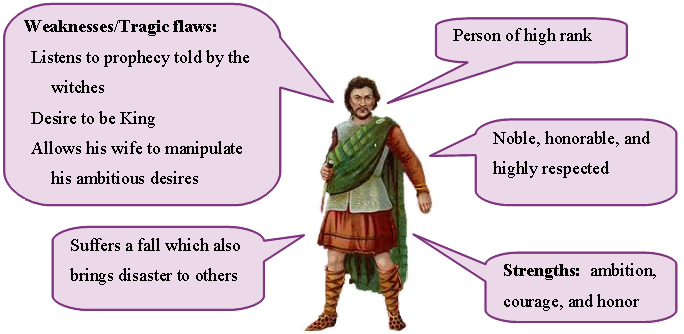
According to Aristotle, a tragic hero is a distinguished person occupying a high position or having a high status in life and in very prosperous circumstances falling into misfortune on account of a “hamartia” or some defect of character. He should be good or fine man though not perfect. There is nothing to arouse the feelings of pity or fear in seeing a bad character pass from prosperity into misfortune while the ruin of a man who represents near-perfection in the moral sense is repugnant and horrible. The tragic hero is neither a moral paragon nor a scoundrel. He should be true to type, and consistent or true to himself. Aristotle would attribute disaster or catastrophe in a tragedy to an error rather than a deliberate crime.

tragic hero oedipus rex

The main requirements of Aristotle in regard to the tragic hero are thus (1) high social standing, (2) moral excellence or goodness, and (3) some fault of character, or error committed by the hero in ignorance. Oedipus answers to all these requirements. Oedipus is a man of royal birth; he is brought up by a King and a Queen and he himself afterwards becomes a King and marries a Queen. He is thus a man of social eminence and possessing excellent qualities of character, though his is by no means perfect. We cannot say that his misfortune is due to any defect in his character, though his defects do produce the impression that such a man must pay for his defects. It would be wrong to say that he is a puppet in the hands of fate. Within certain limits he is a free agent, though it must be recognized that the prophecy of the oracle would yet have been fulfilled.

Oedipus is a good king, a great well wisher of his people, a man of integrity, an honest and great administrator and an outstanding intellect. He is a pious man who believes in oracles, respects the bonds of family, and hates impurity. His belief in the prophecies of gods is the very basis of the whole play. The suppliant people approach him almost as a god and he is honoured as a saviour. When Creon reveals the cause of the city’s suffering, Oedipus declares his resolve to track down the criminal and he utters a terrible curse upon him. We can say that Oedipus is almost an ideal King. He also shows himself as a devoted husband and a loving father. He shows due consideration for the opinions and feelings of Jocasta and he lavishes all his affection on his daughters. His relations with the Chorus are also very cordial and he shows all due courtesy to them. In short both as a man and as a king Oedipus is worthy of high respect.

However, Oedipus has his faults. He is hot-tempered, hasty in his judgment, proud of his intelligence, and random in his decisions. He quickly loses his temper when he finds the prophet reluctant to reveal the things that he knows. He jumps to the conclusion that Teiresias and Creon have hatched a conspiracy against him. This attitude of distrust towards the prophet is in sharp contrast to Oedipus’s genuine piety. Oedipus belongs to the world of politics and human standards rather than to the divine order of the world. His piety fails also later on when, under the influence of Jocasta, he becomes somewhat skeptical regarding the oracle.

An outstanding feature of Oedipus’s character is an inherent feeling of pride in his own wisdom. Because of this arrogance, Oedipus certainly alienates some of our sympathy. When self-confidence takes the form of pride, haughtiness, arrogance or insolence, it becomes disgusting and obnoxious. His attitude of intolerance towards both Teiresias and Creon and his highly offensive and insulting words to both of them create in us the impression that he is paving the way for his own downfall. Of course, Oedipus has already committed the crimes which make him a sinner in the eyes of the god, in his own eyes, and in the eyes of other people. But the tragedy lay in discovery that he is guilty of them. If the crimes had remained unknown there would hardly have been any tragedy. Tragedy comes with the fact for discovery both for Jocasta and himself.

It would be a flaw in the logic to say that Oedipus suffers because of his sin of pride, but his pride is not the direct cause of his tragedy. He tried to avoid the fulfillment of the prophecies made by oracle. He killed his father and married his mother. His tragedy is a tragedy of error. If he had been a little more careful, things would have taken a different shape. He might have avoided the quarrel on the road if he had not been so proud or hot-tempered; and he might have refused to marry a woman old enough if he had not been blinded by the pride of his intelligence in solving the riddle of the Sphinx. But, then, the prophecies of the oracle would have been fulfilled in some other way, because nothing could have been prevented their fulfillment. Pride has little to do with Oedipus’s killing his father and marrying his mother.

If Oedipus had not relentlessly pursued his investigations, he might have been spared the shock of discovery. Something in him drives him forward on the road to discovery. After Teiresias has first refused to tell him anything and then uttered some frightening prophecies. Oedipus is discouraged by Jocasta to continue his investigations. But he pays no heed to her philosophy of living at random. She makes another effort to stop his investigations when she has herself realized the truth, but again she failed. The Theban shepherd too tries, but in vain. It is this insistence on the truth that leads to the discovery in which lies the tragedy. We may interrupt this insistence on the truth as a form of pride, the pride of intellect, or the pride of knowing everything. The link of cause and effect is unmistakable between Oedipus’s pride of intellect and Oedipus’s discovery for his sins. But there is no strong link between his pride and the actual committing of his sins because the sins would have been committed in any case, if the oracle was to be fulfilled. The oracle did say that Oedipus would be guilty of those crimes but no oracle said that Oedipus must discover the truth.

Oedipus is thus an authentic tragic hero in the Aristotelian sense because his tragedy is as much due to his own initiatives in discovering the truth as to external circumstances. To the modern mind, a high social position is not necessary for the tragic hero nor do they recognize the validity of oracles too.

In Oedipus we see the helplessness of man in the face of the circumstances and his essential greatness. The manner in which Oedipus blinds himself after realizing his guilt and in which he endures his punishment raise him high in our esteem. The spirit of Oedipus remains unconquered even in his defeat and that is the essential fact about a tragic hero.

MKRdezign

Contact Form

Name

Email *

Message *

Powered by Blogger.
Javascript DisablePlease Enable Javascript To See All Widget